A point-in-time lab for free alternative data, and what survived it
Insider buying and federal contract awards gave no tradeable edge. Inventory build predicts semiconductor gross margins, but barely moves returns.
- Hypotheses tested
- 3 of 5, each pre-registered
- Insider-buy filing day
- +1.18% abnormal (t 24)
- Inventory build to next-quarter margin
- −1.15 pp per sd (t −3.3)
- Live margin screen, best vs worst fifth
- 9.5 pp over 52 quarters
- Python
- pandas
- DuckDB
- scikit-learn
- LightGBM
AltAlpha is a research platform for testing whether free, public alternative data predicts company fundamentals and stock returns. It turns SEC filings and market data into point-in-time features: every value carries the moment it became public, not the date of the event it describes. I wanted to know which free datasets can be tested honestly, and whether any of them still carries an edge.
How it works #
It started with a survey of what free data a script can reach. Most of the classic alternative datasets (job postings, web traffic, app downloads, satellite and shipping data) are paid. The free ones with company-level history and clean timestamps are insider filings, federal contract awards, Wikipedia page views and Taiwanese supplier revenue. I ranked five hypotheses by data availability and testability, and have tested three so far.
Everything hangs off EDGAR, which stamps each filing with its acceptance time to the second. The store holds 3.49 million insider open-market trades since 2006, 440,233 XBRL filings since 2009 (XBRL is the machine-readable tagging in SEC financial statements) and 417,257 earnings-release 8-Ks. A unit test checks that a 10-K accepted five minutes after a cut-off stays invisible until the next month.
Each study fixes its main tests in code before the first run. Every other variant is logged as a trial and goes into a multiple-testing correction (Holm and Benjamini-Hochberg). Backtests charge spreads, square-root market impact and borrow fees, and are re-run at sizes from $1m to $1bn.
What I found #
| Study | Question | Result |
|---|---|---|
| Insider purchases | Do unusual buys by officers and directors predict earnings and returns? | No. All three pre-registered tests fail; 3 of 150 variants survive correction |
| Inventory build | Does inventory growing faster than sales predict margins and returns? | Margins strongly; returns only weakly |
| Federal contracts | Do contract awards predict contractor revenue and returns? | No. Nothing beyond the company’s own revenue trend |
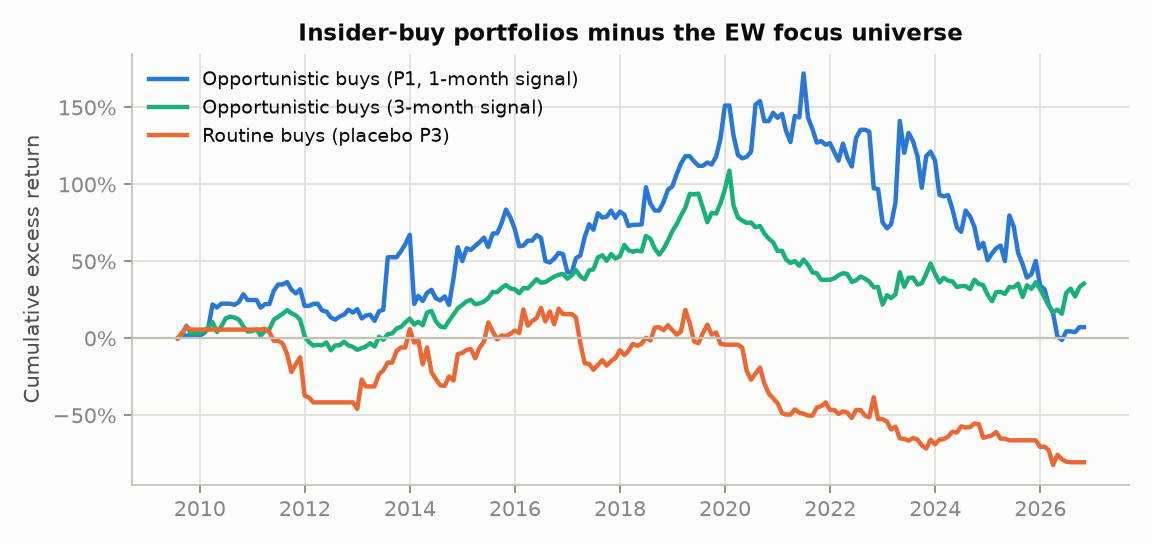
Insider buying is priced within a day. A purchase filing moves the stock +1.2–1.3% on the trading day it becomes public, both in the focus industries (semiconductors, AI infrastructure and defence) and in the broad market. Across the broad market, routine purchases get +0.45% and sales −0.16%. Little is left after that: a month-end portfolio of recent buyers beat its universe by 2.8% a year (t 0.54).
Inventory build predicts gross margins. One standard deviation more build means 1.15 percentage points less gross-margin change next quarter (t −3.3), and the highest- and lowest-build fifths end up 6.7 points apart. The test includes firms that later disappeared and replicates in the rest of the market. The return spread, 8.0% a year (t 1.95), falls just short of significance, and the investable version nets a Sharpe ratio of only 0.37.
Contract awards add nothing. I attributed $2.76tn of USAspending obligations to 29 listed contractors through the parent entity recorded on each action, because the site’s name search returns today’s names for old contracts. Awards correlate with next-quarter revenue growth, but the effect vanishes once current growth is controlled (t −0.09). Ignoring publication lags would have inflated that correlation from 0.12 to 0.17.
A live margin screen #
The inventory result now runs as a live screen of semiconductor and AI-hardware filers, fed by the SEC’s XBRL API within hours of each filing. On 17 November 2026 it scored 107 of 160 companies and listed every exclusion with a reason. Over 52 out-of-sample quarters, the best-forecast fifth beat the worst by 9.5 points of realised margin change (t 10.2). Most of that comes from the margin trend, not from inventory. Build works as a warning, but only where sales are falling or growing by less than 30%.
Limits #
- Free daily prices cover only companies still listed, so every return test is survivorship-biased; the fundamental tests are not. In the insider study, 1,977 of 4,817 purchase events fall in firms with no price data.
- There are no historical analyst estimates, so an earnings surprise is measured against the same quarter a year earlier.
- Without intraday data, the filing-day reaction cannot be tested at the hour level.
How it’s built #
Python, with parquet tables and a DuckDB catalogue as the point-in-time store, statsmodels for the regressions, and scikit-learn and LightGBM for walk-forward models.