A prediction-market lab: fast prices, little edge after fees
A simulated exchange, market maker and arbitrage engine, plus a working paper on 29,703 resolved Kalshi and Polymarket markets and a 13.9-hour live capture.
- Resolved markets studied
- 20,000 Kalshi, 9,703 Polymarket
- Spot move priced within the minute
- 96% (Kalshi 15-minute crypto)
- Replayed strategies on real data
- All lose 5–6¢ a contract
- Simulated market maker
- +$167 an hour, 27 of 32 seeds
- Python
- NumPy
- SciPy
- JavaScript
Prediction markets trade contracts that pay $1 if an event happens, so their prices read as probabilities. This project asks how good those probabilities are once real costs are counted, using a simulated exchange where the true probability is known and market data from Kalshi and Polymarket. It ends in a working paper on five questions: speed, calibration, short-term predictability, arbitrage and liquidity.
How it works #
- A simulated exchange with one-cent ticks, Kalshi’s published fee formula, latency on every order, price-time queue priority and fully collateralised accounts. Each event’s true probability is known exactly, and every experimental arm faces the same information path.
- A market maker that learns fair value only from public quotes and trades, through a Kalman filter in log-odds, and quotes around it with an Avellaneda–Stoikov rule.
- An arbitrage engine that solves a linear program across related contracts (outcome sets, strike ladders, conjunctions) for the best worst-case profit after fees.
- Real data, read-only. 20,000 resolved Kalshi markets, 9,703 resolved Polymarket markets and a 13.9-hour live capture of both venues on 13 November 2026, including 4.73 million Kalshi trades. Only public market-data endpoints were used, under conservative rate limits, and no order was ever placed.
What I found #
| Question | Answer |
|---|---|
| Speed | In Kalshi’s 15-minute bitcoin and ether markets, about 65% of a large spot move shows up in the same second and 96% within the minute |
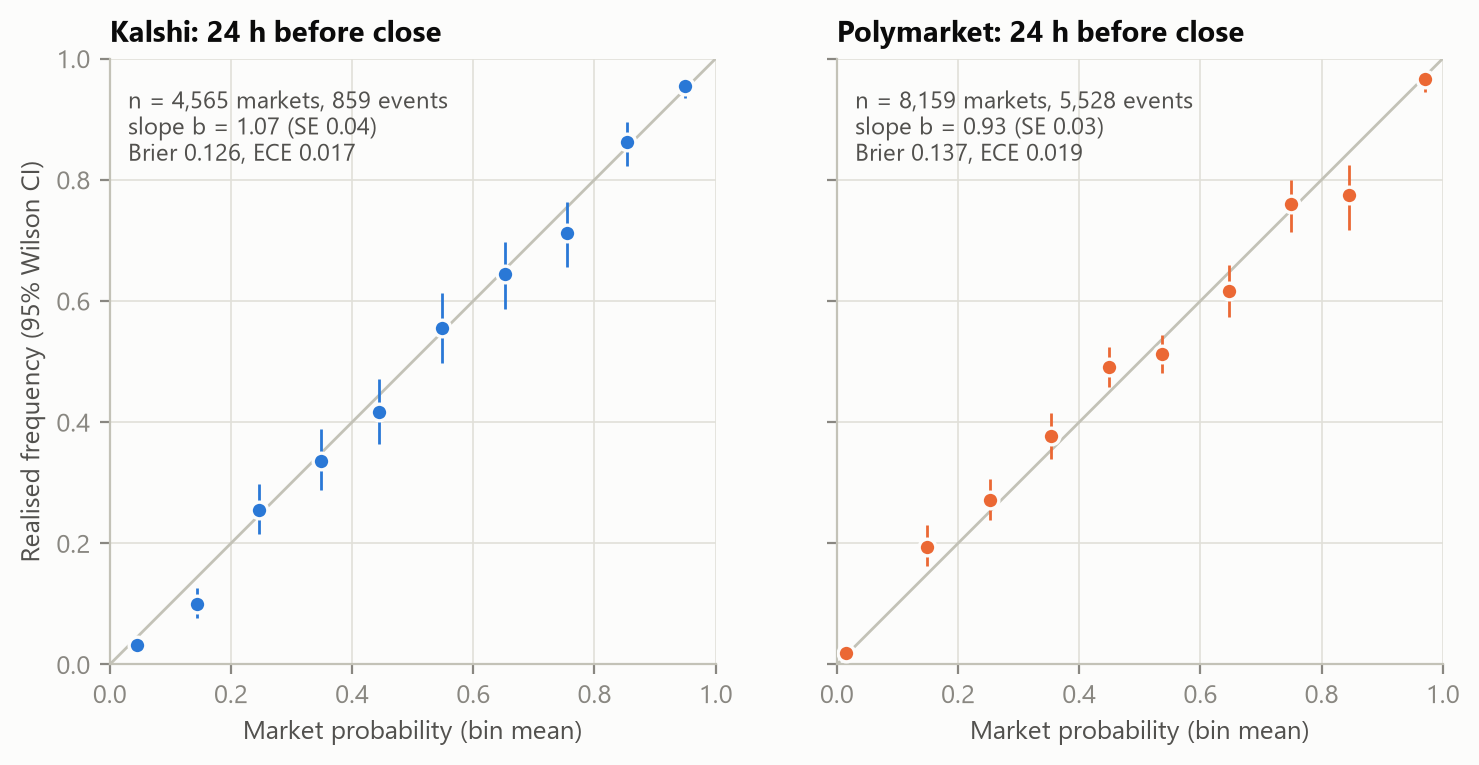
| Calibration | 24 hours before close, Kalshi is mildly compressed towards 50% (slope 1.07, s.e. 0.04) and Polymarket mildly too extreme (0.93, s.e. 0.03) |
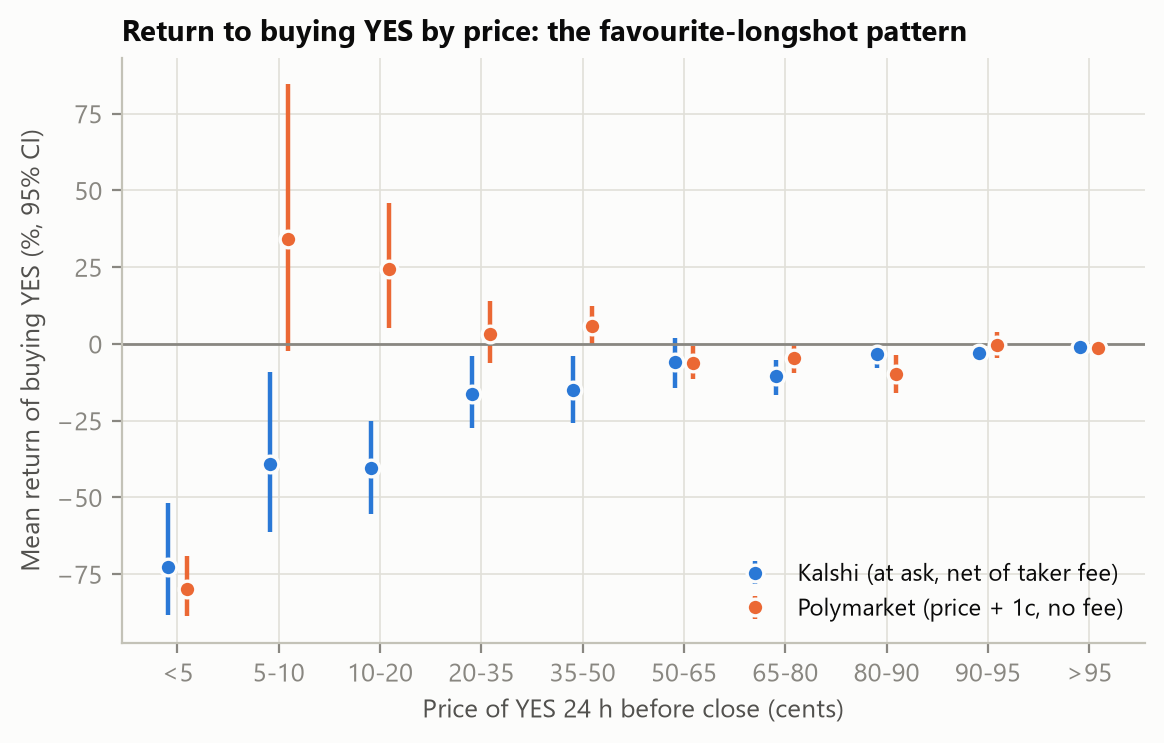
| Longshots | Kalshi contracts under 5¢, bought at the ask, lose 72% after fees (95% CI 52% to 88%) |
| Predictability | Order flow predicts the next 30 seconds (out-of-sample R² 1.5%), but the predictable move, 0.9¢, is smaller than the 1.6¢ cost of acting on it |
| Arbitrage | On complete Kalshi outcome sets, after-fee arbitrage appears in under 1% of snapshots and is gone in about 14 seconds |
None of this is tradable. Recalibration rules fitted on the earlier half of markets do not profit on the later half, and three strategies replayed through the live capture’s 15-minute crypto markets all lose 5–6¢ a contract.
The simulator suggests why the real markets look this clean. With nobody arbitraging, executable arbitrage exists in 99% of scans; a single linear-programming arbitrageur cuts that to 70% and the pricing error against the truth by 30%. Removing the automated market makers raises pricing error by 55%. In the model, market makers and arbitrageurs keep prices coherent.
Market-maker design (32 paired seeds). The default maker earns $167 per simulated hour (95% CI ±$59; profitable in 27 of 32 seeds). Its fair-value model is what earns it: swapping it for the external mid costs $135 an hour. Inventory skew and spread width change risk, not mean profit. A cross-market portfolio skew cost $245 an hour, so it is off by default.
Limits #
- The tick-level evidence is one 13.9-hour recording, dominated by crypto and sports markets.
- The speed study uses Coinbase spot, polled once a second, as a proxy, so sub-second lead-lag cannot be resolved.
- Simulated agents are stylised, so the experiments speak to mechanisms, not to real-world profit levels. Most use eight seeds: enough for pricing error, not for P&L. At eight seeds the market-maker ablations suggested effects that 32 seeds did not confirm.
- The market maker’s default parameters come from an informal sweep that is not part of the reproducible pipeline.
How it’s built #
A Python package with an order book, a discrete-event simulator, pricing, strategy, risk and backtest layers, and a local dashboard. Every simulation run is reproducible from its configuration and seed and writes a manifest with a code hash; the 32-seed suite reproduced the earlier suite’s 16 shared runs exactly. 25 tests cover matching, accounting conservation, pricing and replay. The raw data (about 2.8 GB) is not in the repository: the collectors rebuild the resolved-market datasets, but the live capture was a one-time recording.