Forecasting chipmaker revenue against management’s own guidance
A point-in-time engine built from SEC filings alone. Its models predict how far 50 chipmakers beat their guidance, but not whether they will.
- Revenue error vs guidance, 2021–26 holdout
- 2.30% vs 3.32%
- Quarters beating the guidance midpoint
- 82% of 1,777
- Beat-or-miss calls
- No skill beyond the base rate
- Companies
- 50, 13 since acquired
- Python
- pandas
- scikit-learn
- XGBoost
- SQLite
This engine forecasts next-quarter revenue and gross margin for US-listed semiconductor companies, using only what SEC EDGAR showed at the moment each forecast would have been made. I wanted to know two things: can a model built from public filings beat naive baselines, and can it beat management’s own guidance?
How it works #
- Point-in-time financials. Every 10-Q and 10-K is replayed in the order EDGAR accepted it, so each quarterly number carries the timestamp of the filing that first reported it. Restatements become new versions instead of overwriting history, and targets are always the first-reported values.
- Release times. The time of each earnings release comes from the 8-K filed with it. Each forecast is made at the last market close before that release, when the quarter is over but not yet reported.
- Guidance. A parser reads management’s revenue and gross-margin outlook from 3,198 earnings press releases, whether it is written as a range, a plus-or-minus figure, a table or a bullet list.
- Universe. 50 companies, 13 of them since acquired (Xilinx, Mellanox and Maxim among them), so the sample is not just today’s survivors. A company-quarter counts only if the trailing revenue known at the time was at least $500M.
- Validation. Models are refit each quarter on results that were public before it. Every choice was made on 2013–2020; the 2021–2026 holdout was run once. Significance comes from Diebold-Mariano tests (a standard way to compare two sets of forecast errors) that treat each reporting season as one block of evidence.
What the data say before any model #
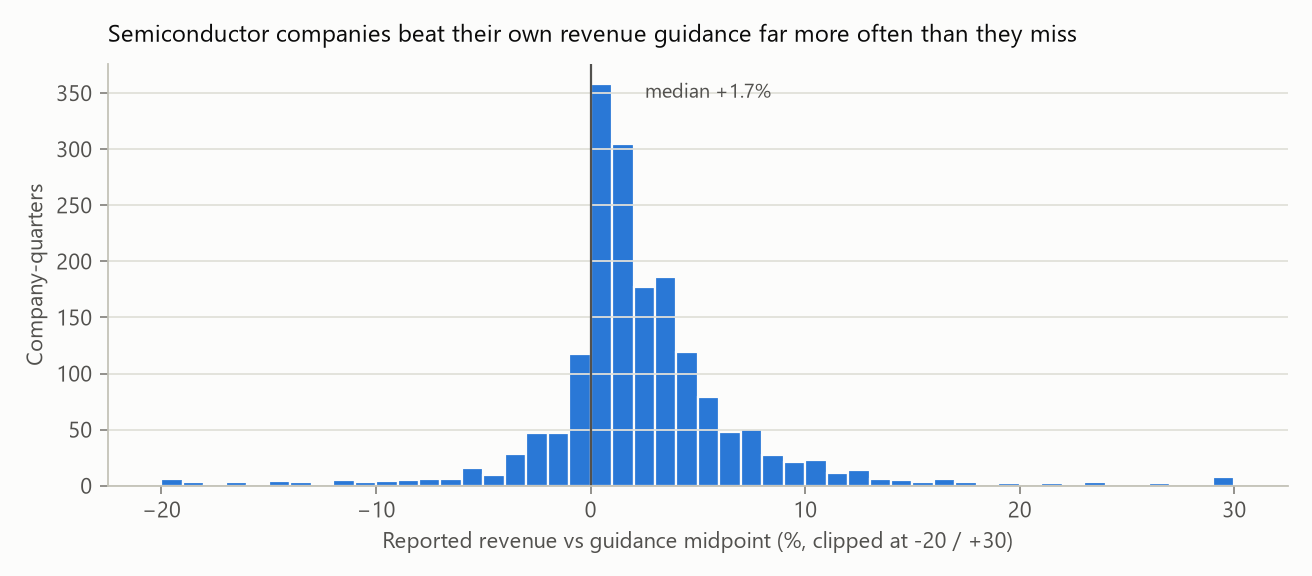
Across 1,777 guided quarters, reported revenue beat the guidance midpoint 82% of the time, with a median beat of +1.7%. 36.5% landed above the top of the range and only 6.3% below the bottom. Beats follow the cycle: 58–62% in the 2011–12 slowdown, 91–95% in 2021 and 2024–26.
Results #
Mean absolute error, in percent for revenue and percentage points for gross margin, except the hit-rate row:
| 2013–20 | 2021–26 holdout | |
|---|---|---|
| Revenue, random walk | 8.36% | 9.29% |
| Revenue, history-only model (XGBoost) | 7.03% | 7.37% |
| Revenue, guidance midpoint | 3.59% | 3.32% |
| Revenue, guidance plus modelled beat (random forest) | 3.08% | 2.30% |
| Beat-or-miss hit rate, model vs “always a beat” | 76% vs 78% | 90% vs 90% |
| Gross margin, lasso vs random walk | 2.14 vs 2.27 pp | 2.05 vs 2.40 pp |
- History-only models beat random walks, historical averages and a linear baseline in both periods, and for 95% of companies in the holdout.
- Guidance is still about twice as accurate as anything built from history.
- The beat model gets closer to the reported number than guidance does (31% less error in the holdout) and ranks which companies will beat by more (rank correlation 0.42). It has no skill at calling whether a company will beat at all.
- The gross-margin gain is narrow: only 53% of companies improve in the holdout, and where a company guides GAAP margin, its own guidance is unbeaten.
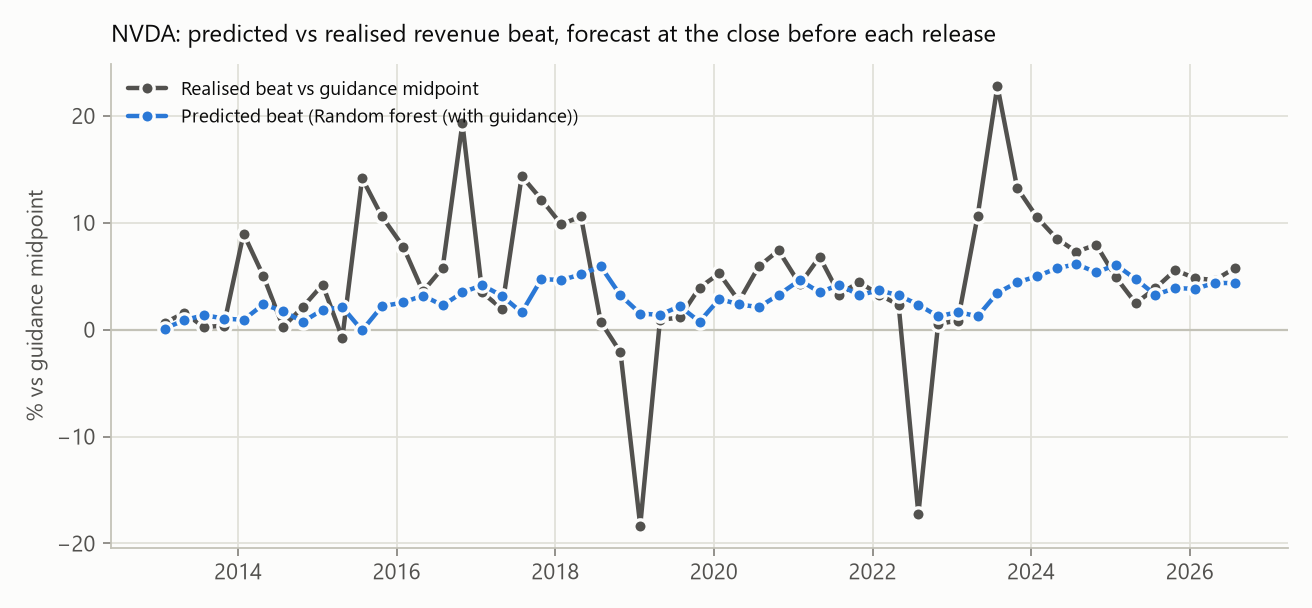
NVIDIA shows both sides. The model learns its habitual beat of a few percent and has tracked it closely since 2023. It does not see the breaks that matter most for a stock: misses of −18% in early 2019 and −17% in mid-2022, or the +23% beat in mid-2023.
Limits #
- No analyst consensus and no prices yet. Investors already expect chipmakers to beat guidance, so a predicted beat over guidance is not a predicted surprise over consensus, and nothing here is a return signal.
- Guidance covers about 78% of releases. Some companies gave their outlook only on the earnings call.
- The features were chosen in 2026 with knowledge of the AI cycle. The holdout guards against fitting to it, but not against picking features that look obvious only in hindsight.
How it’s built #
Python with pandas, scikit-learn and XGBoost, and SQLite for the parsed guidance. Point-in-time audits check that every forecast precedes its release, every guidance figure precedes its forecast and no version of the target quarter leaks into the features. One audit caught three quarters where a 10-Q had been filed before the earnings 8-K. The first run downloads about 1.1 GB from EDGAR; everything after that runs from cache.