A chess trainer built from my blunders in over 12,000 online games
Stockfish checked every move of my online games against my opponents’ moves in the same games, then 1,212 of the positions became a browser trainer with spaced repetition.
- Games checked by the engine
- 11,907 (819,411 positions)
- Biggest leak
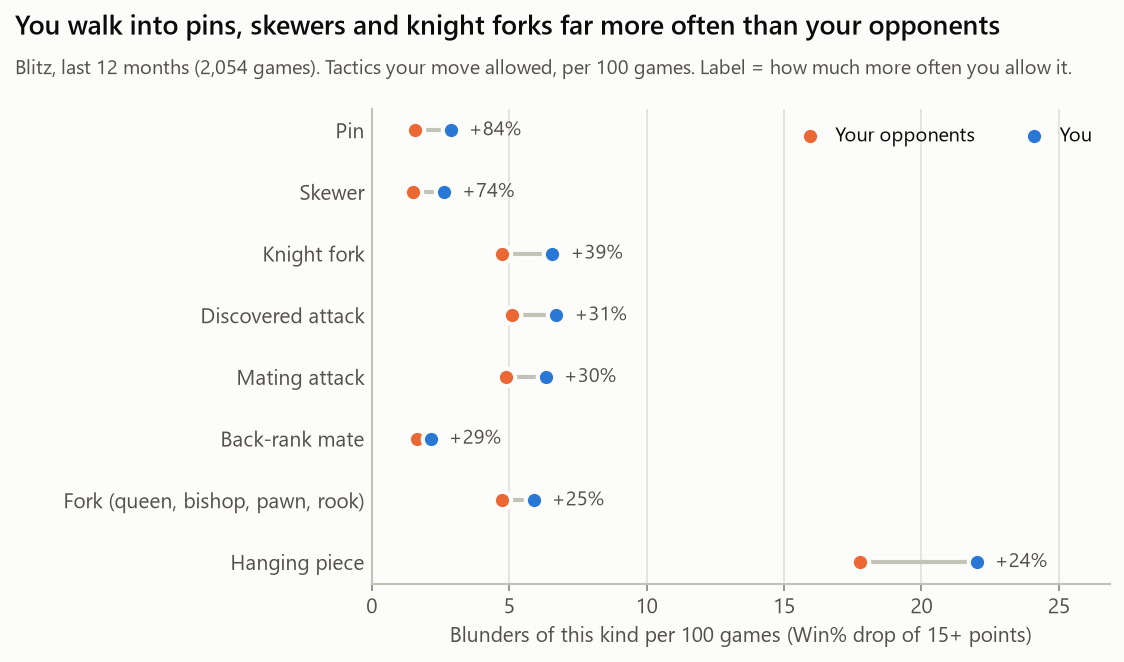
- Pins allowed 84% more often than my opponents
- Trainer positions
- 1,212 from my own games
- Python
- Stockfish
- JavaScript
I have played more than 12,000 online chess games since 2018, and my results match my rating. So the useful question is not whether I make mistakes, but which mistakes I make more often than the players I meet. This project answers that with an engine review of every game, then turns the answers into a trainer.
How the review works #
- Data. 12,217 games from the chess.com and lichess public APIs, from September 2018 to October 2026. Stockfish 19 checked every move of the 11,907 standard-chess games: 819,411 positions.
- The baseline is my opponents. Every comparison is me against my opponents in the same games: players at my rating, at the same time controls, in the same kinds of positions. That separates real leaks from noise in a way that comparing with an engine cannot.
- Calibrated engine budgets. 20,000 to 60,000 nodes a position, depending on the time control, chosen after a 30-game calibration against a one-million-node reference. Blunder flags matched the reference with precision 0.91 and recall 0.85-0.88.
- Checked scoring. Win% and the blunder threshold (a drop of 15 Win% points) follow lichess’s formulas. On 425 games, my Win% correlates at 0.991 with lichess’s own server analysis.
- A second pass. All 50,158 blitz and rapid blunders were searched again for full lines and tagged with a tactical motif such as a fork, pin, skewer or back-rank mate. Every example was re-verified at 1.5 million nodes, and 510 of 516 held up.
What it found #
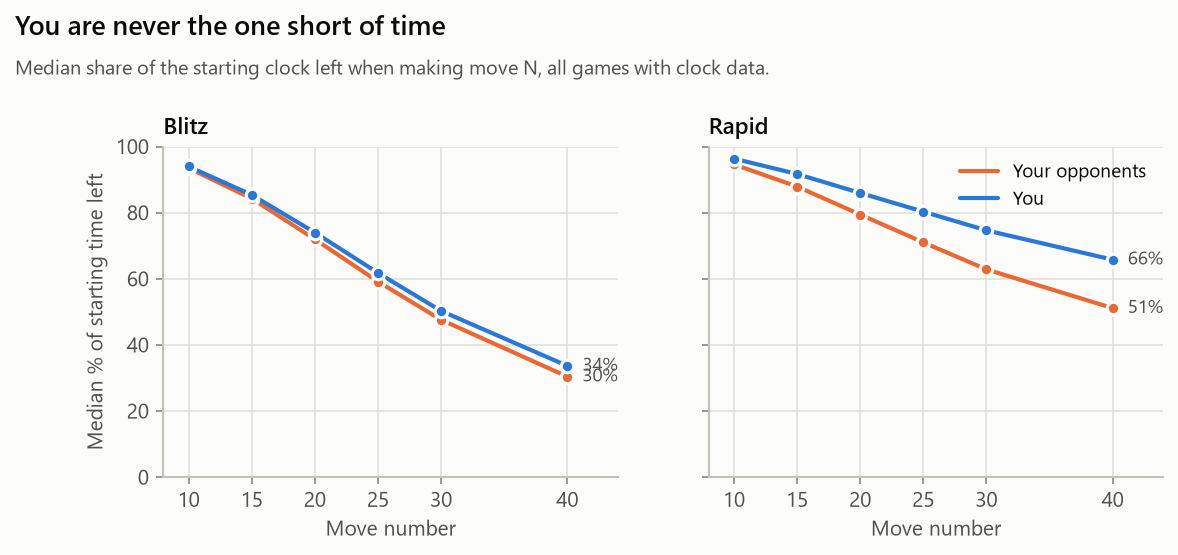
- I walk into tactics more often than my opponents, mostly in level blitz middlegames. Over the last 12 months of blitz (2,054 games), my moves allowed pins 84% more often than theirs, skewers 74% more often and knight forks 39% more often. It isn’t time trouble: in 92% of the blitz games I lost to a single blunder, I still had more than a fifth of my clock.
- I play rapid too fast. I reach move 40 with two-thirds of my clock left, against my opponents’ half, and 21% of my moves take under a second (theirs: 7%). In blitz the same speed is a weapon: opponents lose on time to me 4.6 times per 100 games, and I lose on time to them 1.6 times.
- Four opening spots cost points, each confirmed by a deeper engine check.
- Strengths to keep: converting won positions, endgames, defending bad positions and not tilting after losses.
The trainer #
A static web page drills 1,212 positions from my own games, weighted towards the patterns the review flagged. The engine graded every legal move in each position, so any move that holds counts as right, not just the engine’s first choice. There are six drills:
- Spot the threat: play the reply that punishes the move I actually played.
- Find a safe move in the position before the blunder.
- Safe or blunder?: a quick judgement of a candidate move.
- Missed shots: find the punishment for an opponent’s mistake I let go.
- Opening fixes: repeated opening positions where my usual move scores badly.
- Daily mix of the above, due reviews first.
Spaced repetition brings a solved position back after 1, 3, 7, 16, 35 and then 75 days, and a missed one within about ten minutes. An optional clock adds blitz-style time limits, and progress is saved in the browser. The review also produced three study files of my own positions for lichess.
Limits #
- The motif labels are heuristic, modelled on lichess puzzle themes and checked by eye on about 60 positions. Both sides get the same labeller, so the gaps are more reliable than the raw counts.
- Opponents change from game to game, so the comparison is with the average player I meet.
- Patterns such as “fast moves blunder more” are associations, not proof of cause.
How it’s built #
A chain of Python scripts fetches the games, normalises them, runs Stockfish on every position, extracts features, re-checks the blunders, tags motifs, computes the metrics and draws the charts, saving every table as CSV. The trainer is plain HTML, CSS and JavaScript with no server.