Reading Axon’s government business from public procurement records
A traceable database of federal awards, city payments and council approvals, and an operating model built on it. The data explains demand, not quarterly surprises.
- Axon federal obligations
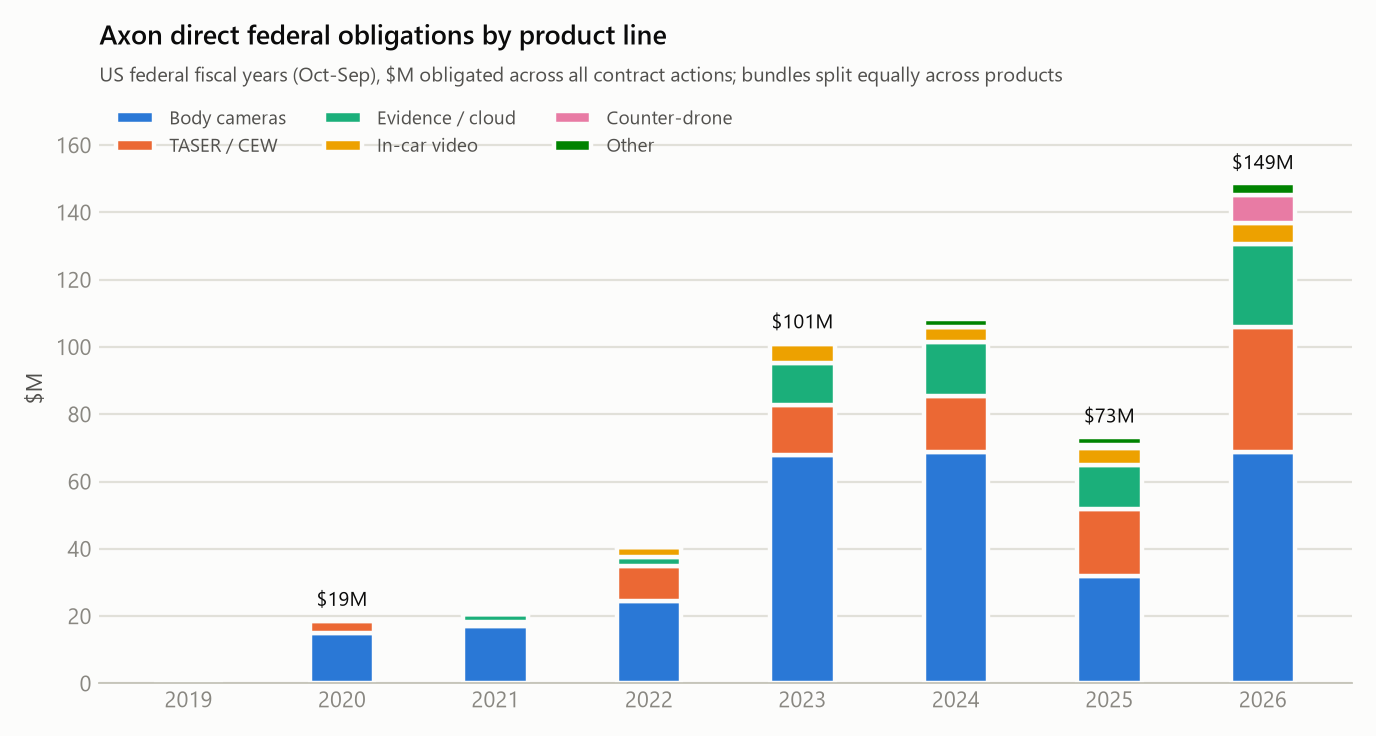
- $19M (FY2020) to $149M (FY2026)
- Federal dollars awarded without competition
- 71%
- Council items read
- 4,905 from 202 councils
- Procurement data vs revenue surprises
- No signal in 23 quarters
- Python
- SQLite
- pandas
- Excel
Axon Enterprise sells TASER devices, body cameras and evidence-management software to police forces and other government agencies. Its customers buy in public, so much of its business leaves a paper trail: federal contract records, city payment ledgers and council agendas. I wanted to know how much of that business those records reveal, and whether they help forecast revenue.
How it works #
The pipeline collects procurement records naming Axon or its competitors, each traceable to its raw source:
- Federal: USAspending contract records for FY2008–FY2026 (19,642 awards and 31,143 modifications), plus SAM.gov solicitations and sole-source notices.
- State and local: payments in about 50 open-data checkbooks and New York City’s, co-op purchasing sales in Texas and Washington, and 4,905 council items from 202 city and county councils.
- Context: the EFF’s Atlas of Surveillance (police technology deployments by vendor) and Axon’s own SEC filings.
The records hold four kinds of dollar figure, and they are never added together: federal obligations (money legally committed), ceilings on contract vehicles, council-approved values (usually multi-year maximums) and payments. None of them is treated as revenue.
63 federal awards matched FPDS, the federal system of record, field by field on dates, obligations and competition. Manual samples found reseller attribution right in 38 of 40 cases and 27 of 30 council approvals to be genuine Axon purchases. Each error became a rule with a regression test, from a medical-device brand that shares the Axon name to body-worn antennas that are not body cameras. Council attachments sit on hosts whose robots.txt blocks all crawlers, so terms and renewal dates come from each item’s full text via the Legistar API, with the supporting sentence kept verbatim.
What I found #
- Federal orders are lumpy but rising. Direct obligations went from $19M in FY2020 to $101M in FY2023, dipped to $73M in FY2025 and reached $149M in FY2026.
- Most federal money is not competed. 71% of Axon’s federal dollars were awarded without competition, and the median award drew one offer. When the Bureau of Prisons opened its body-camera and evidence contract to competition in 2026, Motorola won the $78M award from four offers.
- Local spending tracks reported revenue. In the open-checkbook sample, payments to Axon grew 28% a year from 2019 to 2025, against Axon’s reported 31.5% for US revenue. Existing customers spend about 1.2 times as much each year, and 89% of paying governments pay again the next year.
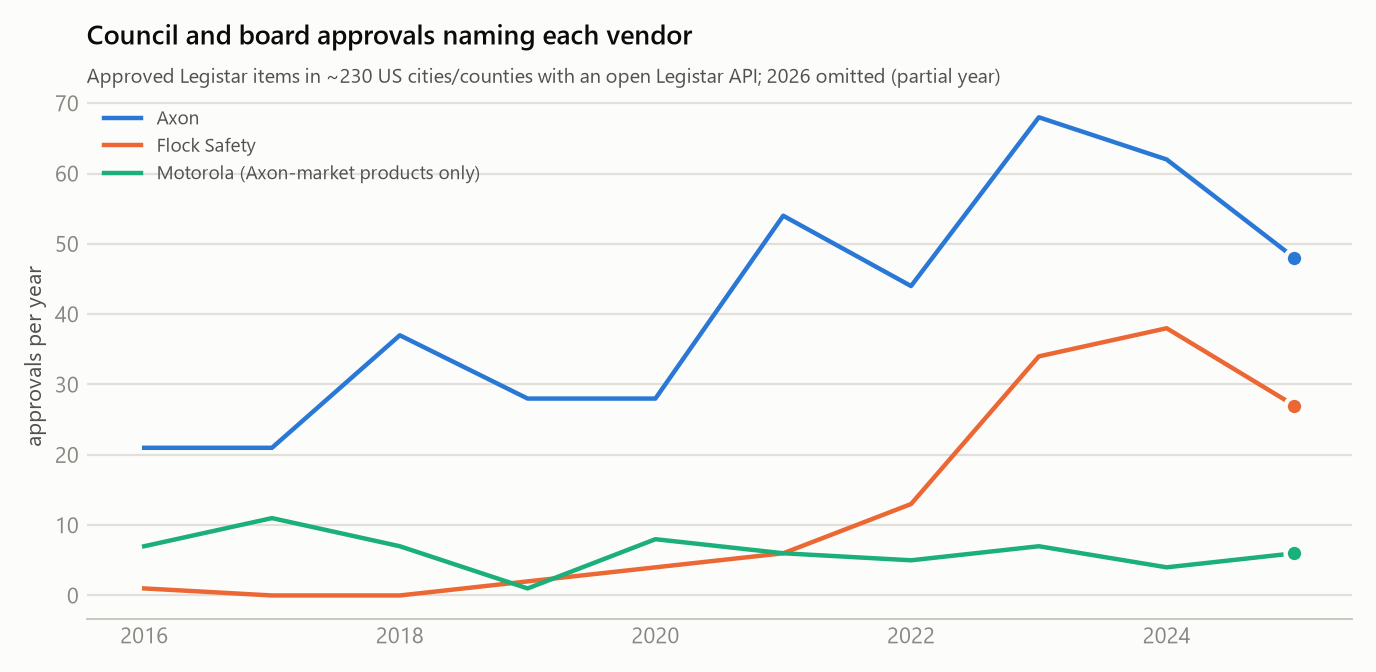
- The contested front is licence-plate readers. Flock Safety holds 88% of named deployments, and its council approvals rose from 0–6 a year in 2016–21 to 34–38 in 2023–24.
- An expiry calendar dates 437 contracts and vehicles ending in 2026–2028, each with the basis for its date.
The operating model #
A quarterly model for FY2019–FY2030 forecasts revenue and gross profit by product line, in separate low, base and high cases. The procurement data sets the growth anchor for software and services (the same-customer spend ratio), the run-rates and odds of federal renewals, and range checks on US growth. Base revenue is $6.5B in FY2028 ($5.4B to $7.8B across the cases). The growth paths dominate: the three largest each swing FY2028 revenue by about $0.6B, while any one contract event moves it by about $50M at most.
Two tests came back negative. An installed-base refresh model could not be calibrated without unit counts and prices, so it was dropped. And in a 23-quarter backtest, no procurement indicator predicted quarterly revenue surprises: the data follows multi-year demand, not the quarter in which revenue lands.
A formula-driven Excel version, checked cell by cell against the Python engine, adds a discounted cash-flow valuation. Its base case gives about $186 a share, against a market price of $315 on 11 November 2026, and $21 to $632 across the low and high cases.
Limits #
- State and local coverage is a sample of governments that publish their data, not a national total.
- Seat counts and unit prices sit in those council attachments, which stay unread.
- Reseller sales with generic descriptions such as “cameras” cannot be attributed to any vendor.
How it’s built #
Python and SQLite, with one HTTP client that checks robots.txt, throttles per host and caches every raw response with a timestamp and checksum, so re-runs reproduce the same figures offline.